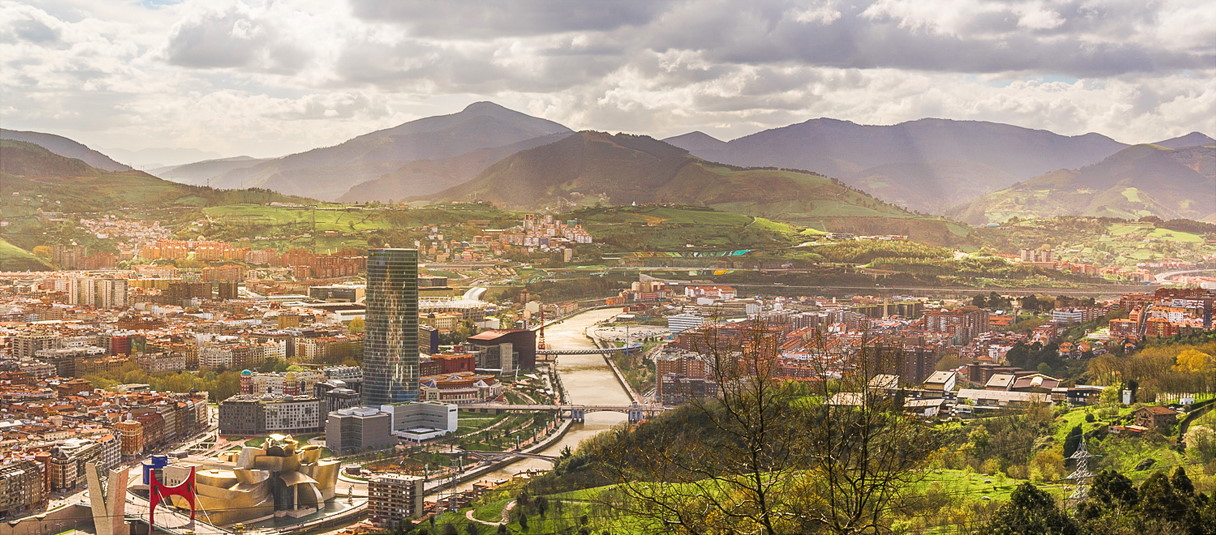
Celebrated for the "Guggenheim Effect" that transformed it from a declining industrial center into a cultural destination, Bilbao is recognized today for its people-centered digital ecosystem and sustainable urban growth.
Digital and Physical Connectivity
Bilbao’s digital strategy focuses on providing ubiquitous, high-speed access to drive economic and social progress. Broadband reaches more than 95% of premises, and a widespread municipal WiFi network brings wireless service to within 300 meters of every resident. Riding on this infrastructure is an urban service platform managed by BilbaoTIK, the municipal agency for ICT, supporting the Bilbao 2030 Digital Transformation Agenda. The Agenda focuses on creating an innovative, environmentally friendly economic environment and fostering a digital lifestyle for its inhabitants.
Physical connectivity is equally available, with 75% of the population having access to public transport within 300m. Low speed limits on roadways incentivizes the use of such transport, and the network of trams, buses and metro run on hybrid or electric energy.
Future Workforce
The city prioritizes STEM education to prepare its workforce for career success in the digital age. That education is linked to employment and economic development through an array of higher education and research clusters. An Industry Association for Applied Knowledge and Technologies collaborates with universities on skills development for industries in the midst of technology transition. An Audiovisual Cluster brings together major companies in that sector to collaborate with educators on talent development. The Basque Biocluster does the same for companies, public administration agencies and other organizations in life sciences, while the EduTech Cluster focuses on the intersection of education and technology.
The Higher Education and Research Cluster for the Creative and Cultural Industries is an ecosystem of collaboration aimed at maintaining Bilbao’s lead in these industries. With support from the Basque Government, it brings together 27 faculties, colleges and companies.
Island of Innovation
The Zorrotzaurre district serves as Bilbao’s premier urban laboratory. The origins of this 2.5km peninsula go back to the 19th Century, when it was home to the city’s shipbuilding sector. By the end of the 20th Century, it was a decaying and flood-prone post-industrial zone that was targeted for regeneration. The 2018 completion of a canal turned the peninsula into an island as part of a flood prevention program that included elevation of ground level and installation of flood protection walls and systems. Two bridges have been completed to connect the island to the rest of the city.
On this improved foundation, Bilbao and the private sector are constructing a mixed-use development of office buildings and more than 5,400 new dwellings, of which half are subsidized housing to ensure social integration. The district is becoming a living lab for the energy transition that tests smart metering, grid monitoring and digital services management. Geothermal and hydrothermal systems create Positive Energy Districts to help achieve a net zero emissions island. A Technology Campus hosts companies specializing in AI, big data and Internet of Things technology
Centering on People
Bilbao’s technology focus has a strong focus on the long-term welfare of its people. It has established BBK Kuna, known as the “house of the Sustainable Development Goals (SDG),” to act as a center for co-creating solutions that improve residents’ lives. The city also offers “brain training” games in public parks to help keep its elderly population – who make up about one quarter of the whole – digitally and mentally engaged. Residents who subscribe to a participatory budgeting platform can also propose and vote on projects to ensure that their views influence the continuing development of the city.
Bilbao ranks among world’s top cities for sustainability, according to the Global Destination Sustainability Index. In addition to making public transport attractive, the city’s 30 kph speed limit significantly reduces both noise and pollution. Bilbao aims to achieve climate neutrality by 2030 through integrating the SDGs into planning, building renovation, the electrification of transportation, growth in renewable energy and green spaces. City organizations, like the Bilbao Convention Bureau, have adopted circular economy models to reduce waste and prioritize local, sustainable products.
Our digital century has conditioned us to expect instant answers. But transforming a city takes time. The Guggenheim Museum, designed by architect Frank Geary, opened in 1997 as a symbol of change for the city, its people, and millions of tourists who would soon descend on Bibao. After that milestone, decades went into creating the policies, investment, infrastructure and engagement that produced the city of today. As the pace of global economic change accelerates, Bilbao will need to call on the same vision, determination and patience to maintain its progress.
Population: 344,408
Website: www.bilbao.eus
Smart21 2025
Showing 1 reaction