
 The city is the capital of a region known as “Europe’s Orchard,” though it lies in one of the driest corners of the continent. Hundreds of kilometers of fruits and vegetables grow in irrigated tents that control evaporation and filter sunlight, powering an export industry that sends produce across Europe and around the world. Agricultural innovation and the city’s position as a regional capital have given Murcia and its 470,000 people the gift of a stable economy.
The city’s leaders, however, have not been satisfied with stability at a time of epic change in technology, markets, employment and climate. In 2015, then-Mayor José Ballesta asked his team to rethink how municipal government should be organized to apply digital technology to manage the challenges of climate change while improving the lives of citizens and supporting economic diversity and growth. The mayor was launching his city on an Intelligent Community Journey.
My Murcia, Your Murcia

When work began, government was entirely paper-based and siloed by department. The contrast with today could not be greater. All data systems have been integrated, using an open-standards solution developed by the European Union, and now power a GIS-based digital twin of the city called MiMurcia (My Murcia). One of its many functions is helping the city deal with flash flooding. Major floods in 2024 alerted Spanish cities to the danger and the digital twin lets Murcia predict and monitor flooding and identify problems with pumping stations and sewage backup. It automatically alerts first responders to emergencies without waiting for citizens to call for help.
The digital twin’s true power, however, is visible in TuMurcia (Your Murcia). This phone app gives citizens transparent access to the city’s data as well as a wide range of news, information and interactivity. Designed to be native to IOS and Android, it adapts to prioritize each user’s favorite functions and plays a major role in public engagement projects. The most memorable involved relocating two rail lines underground in a major construction project that impacted 20% of residents. Where such a project would be mired in controversy in most places, Murcia turned it into a learning partnership that deepened citizen engagement in their city. A three-year program brought together residents and architects online and face-to-face in an open innovation program to co-create the new property that would result. The city committed to turning citizen priorities into a binding roadmap for development, and the design choices of residents – including parks and heritage rehabilitation, neighborhood squares and underground utilities – were integrated into the technical specifications of project tenders.
Triple Helix at Work
Home to two universities and a vocational school, Murcia faces the familiar challenge of retaining each year’s graduates, as well attracting workers from the community and beyond to its growing economy. The city has built an ecosystem connecting education, government and business to do the job.
 Graduates typically leave university knowledgeable but with little practical experience. To bridge that gap, the city partners with the University of Murcia (UM) and 6,000 businesses in a Guidance and Information Center. The Center staff analyzes each student’s profile to design a professional trajectory focused on fields in high demand, from biochemistry and agtech to digital services. It then offers a robust internship program providing students with up to five months of full-time immersion in a company, in which they lead projects and deliver measurable value. Workshops offer additional instruction on how to enter the workforce, focusing on managing a digital identity, networking, “soft skills” and mastering the modern recruitment process. The results are impressive: 78% of students begin full-time work shortly after graduation and 64% secure permanent contracts with employers.
A Mixed Employment and Training Program offers similar support for vocational students. The city acts as a direct employer of vocational students, who split their time between classroom instruction in vocational schools and on-the-job execution through employment in 12-month apprenticeships on city infrastructure projects. Graduates gain professional certificates that are valid across the EU, and the city provides intensive staff support to develop soft skills, a strong work ethic and a career pathway with local businesses. More advanced skills development is available through training supported by the Regional Federation of Metal Entrepreneurs and the Murcia Chamber of Commerce. Students receive technical training in industrial processes, automation and smart warehouses, then participate in paid internships at Murcia companies.
Homes for Innovation
Innovation in agriculture has built today’s strong economy. An example is a company called AMC Global. The family-owned firm grew organically for decades as an international provider of the fruits and vegetables grown in the region. Growth took off, however, when the company innovated into developing natural fruit and vegetable-based drinks. To keep pace with market demands, it manages an average of 2,000 mostly white-label products and introduces 400 new ones each year, a rate of product turnover requiring continuing marketing intelligence, R&D and data systems.
For the past decade, Murcia has marshalled public and private funding to accelerate similar innovation in technology industries. One “home” for this innovation is the European Business and Innovation Center on the UM campus, which provides an average of 120 startups with mentoring in business modeling, intellectual property protection and internationalization. Its open innovation programs connect them with regional industrial companies to solve their technology challenges. Completing these services, the Wannaseed Investment Ecosystem channels private investment from angel and venture investors into seed and scale-up funding. Together, these organizations have advised more than 2,400 companies and incubated industry-leading companies in medical technology, online communities and data intelligence.
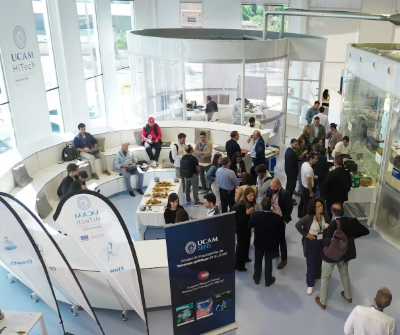 Tech innovation finds a second home at the UCAM HiTech Hub at the Catholic University of Murcia. It offers state-of-the-art laboratories for genomics, biomechanics and food technology and a living lab model that exploits UCAM’s ties with elite sports and the healthcare system. The Hub’s core mission is to commercialize knowledge generated by university research group, and this mission is aided by a nonprofit business cluster in digital health called TicBiomed, which supports market entry and scale-up. Through deep relationships with healthcare organizations in Spain and beyond, TicBiomed identifies challenges that they face and matches them with technology solutions developed by Murcia companies and startups.
Going Digital
Murcia’s broadband needs are well served by seven national and regional operators, with fiber networks passing 97% of all premises and 99% mobile coverage. But so many governmental and business processes have gone online that the 20% of Murcians who lack adequate digital skills face a new form of inequality. The city has created a digital support team of Human Mentors working in in neighborhoods and outlying districts to provide training and mentoring, supported by an online instructional platform that has 85,000 active users. More advanced training is available in the urban core at the Central Cloud Hub, which provides weekly training programs serving an average of 1,500 people per year.
The Acelera Pyme Office provides similar support to small-to-midsized businesses. Technicians conduct digital maturity audits and design technology roadmaps for each business. Upskilling programs in AI, online marketing and cybersecurity improve competitiveness. The Office also guides companies through application for EU grants to purchase technology and connects them with local companies able to support installation and operation. In the most recent year, the Office helped companies access more than 90 million Euros in public and private funding for digital transformation.
On the Leading Edge of Climate Change
Southern Spain is on the leading edge of climate change: an already arid region now buffeted by torrential rainstorms, drought and extreme high temperatures. Murcia’s response involves government, business, homeowner associations and private citizens, with a Murcia Local Energy and Climate Change Agency at the core. Funded by Murcia and national and EU programs, the Agency monitors the city’s environmental footprint, promotes clean energy generation on rooftops, expands EV charging networks and provides advice to families and homeowners on renewable energy. Its work is central to Murcia’s compliance with GHG reduction targets.
Meanwhile, Murcia’s Plan Foresta is planting 100,000 resilient, long-lived trees in the city by 2030, doubling the tree cover. The program aims to reduce summer temperatures by increasing shade and to mitigate climate change by absorbing tons of CO2 each year. Many of those trees are growing in a new riverside park, the result of a massive restoration project that has transformed an industrial dumping ground into a point of pride for the community.
Mayor Ballesta was still in office in 2026 when he passed away after a 2-year battle with cancer. The city he left behind has been transformed for the better through the dense network of partnerships the local government has forged. As one entrepreneur put it, “This is a big change from 15 years ago, when there was nothing here. Now there is a network of companies in a comfortable and safe city with affordable housing and plenty of help from both government and businesses. Everything we need is here.”
Population: 472,000
Website: web.murcia.es
Smart21 2026
Showing 1 reaction