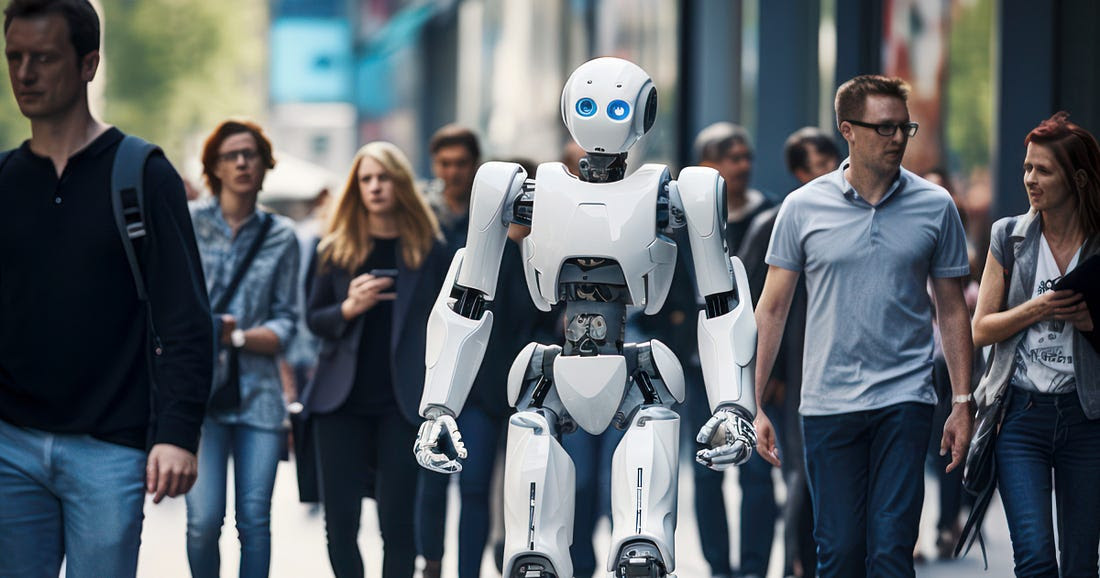
Public Mobile Robots and you! Source: https://marketplace.eiturbanmobility.eu/insights/advancing-public-area-mobile-robots-a-municipal-guidebook
Like Paul Revere’s famous ride in 1775, warning that the British were coming, the call came out: the robots are coming, the robots are coming! I was asked to speak about the impact of Public Mobile Robots (PMRs) accessing the public realm, especially sidewalks, through the lens of an urban planner and urban designer. I thought, OK, I could do that, but first I need to speak with other planners who have actually worked with them. I hadn’t, but I was aware of them from the Intelligent Community Forum’s partnership with the Toronto-based Urban Robotics Foundation that had done a lot of foundational work on the topic.
For more blog posts like this, subscribe to John G Jung's Substack Newsletter here.
However, I was surprised that city officials weren’t circling the wagons amid concern that robots would be taking over our streets and other public spaces to the detriment of our quality of life. “It’s just not on our radar,” said more than one city planner when I probed whether their city was ready for their introduction.
It’s not like we need to wait for the technology to evolve. Have you seen the choreography that the Unitree G1 Humanoid Agent AI Robots displayed this past Christmas? What would be your response to a proposal to allow these highly agile humanoid robots, no, wait…even just simple 3-wheeled robotic delivery boxes to travel along a public sidewalk to deliver a Starbucks coffee, with or without sugar?
I had to admit that I too was one of those planners who hadn’t considered the introduction of robots into the public realm. It just wasn’t on my radar. And I usually prided myself on being somewhat forward-thinking. Or so I thought. So, I am as much to blame as my colleagues.
The panel was a lot of fun and very insightful. The discussion made it clear that the issue was not in the advancement of the technology but rather in the governance gaps of cities. Many cities are, in most cases, not prepared for what is possible now, and in the next decade or two. Remarkably, we have planned for land uses, traffic, and even the challenges of integrating bicycles into the urban realm, but the lowly sidewalk seems to have become the planner’s last frontier.
In preparation for this panel, I looked up the Urban Robotic Forum’s website and read their insightful White Paper: Robots in Public Spaces. For planners, it is a must-read. Sidewalks seem to have been a leftover parcel of the street, relegated to pedestrian passage and other things, like street trees if there was room to plant them. Several years ago, I contributed to a book called Streets for All. While autonomous vehicles were part of it, sadly, robots in the public realm were not.
 |
5G Patrol Robot Debuts In Shanghai. Source: https://www.tourbon.com/news/5g-patrol-robot-debuts-in-shanghai-27002965.html
Think of it this way - all land use planning and traffic planning in policy and operations has been involved with designing with humans in mind. But now we are being asked to look at a future when potentially autonomous PMRs might roam our streets, sidewalks, lanes, and parks. How do we plan for them? From my perspective, we should still plan from a human-centric perspective, which I deem higher on the priority level than planning to accommodate robots. Yet, we need to design, or co-design with stakeholders in mind, especially to deal with situations that might develop should humans and PMRs come in direct contact (or conflict) with each other. Or how about when multiple PMRs come face to face and can’t get past each other on the sidewalk? Or when loading and unloading occurs from the curb or when an emergency takes priority at an entrance to a building? Or, heavens – some things that planners might not be able to plan for, such as if a PMR comes face to face with an unruly dog on a narrow passageway or a gang of kids “socializing” on a street corner decides to have some fun with it. I think you get the idea. Conflicts. Competition for space. The unruly and unexpected. I am sure the robotics vendors have come across these and other scenarios and developed solutions after thousands of pilots. But every city, every situation, and every sidewalk may be different. These scenarios would even give an AI a headache.
Currently, we are seeing many pilots aimed exclusively at developing regulations to govern traffic-related matters dealing with autonomous vehicles on public roadways. But there are few cities that have the necessary governance in place to deal with autonomous devices of any kind on public sidewalks. Let that one sink in. We have apparently planned just about everything, just not for sidewalks.
Really? You might ask. We give permits to cafes that must meet specific rules and we might have minimum sidewalk setbacks from buildings to the curb. We have ways to deal with potential obstructions such as bike racks and rentals for e-scooters. We have regulations regarding placement of EV chargers, bus stops, and other things along the curbline such as loading and unloading zones. We may even have sufficient width along our street to provide dedicated bike lanes and even street trees. And along many new streets and sidewalks, we see curb cuts at intersections along with button tiles or raised bars indicating directional cues for the blind. But these are all reflecting humans and human activities. Nothing comes to mind about how to integrate non-human public mobile robots with humans along the sidewalk, at intersections, and in public parks.
But we are getting there. Slowly. Some pilots have been undertaken that give us an indication of how we might deal with PMRs as they come into our communities. We call these best practices or urban solutions. For instance, look at Milton Keynes in the UK. That city became the world’s most visible testbed for PMRs in 2018 when a Tallinn-based company, Starship Technologies, launched the world’s first pilot. By 2020, it had expanded into a fully commercial service with Tesco and Co-op supermarkets. It scaled into the world’s largest PMR fleet, completing hundreds of thousands of grocery and food delivery trips across the community. The trials resulted in significant support by the public, pointing to a reliable ability to navigate the community’s wide sidewalks, and demonstrating a clear value for short-distance deliveries. Consequently, the deployment is still ongoing. A terrific best practice. However, Milton Keynes did not develop a formal regulatory framework from this pilot. Its wide sidewalks and planned urban form resulted in a relatively easy deployment that many cities with narrower sidewalks might not be able to achieve. Consequently, governance for Milton Keynes remained informal, allowing pilots rather than requiring them to meet codified municipal rules. So maybe not a best practice for all cities to emulate. But a great example of perserverence and success.
In North America, four cities stand out as best practices for me. In the USA, Boston has a multi-agency coordinating committee, considered to be the strongest PMR governance example in North America. In Columbus, Ohio, Smart Columbus includes cross-department governance for AVs, curbside automation, and delivery robots. San Francisco stands out as a city utilizing multi-agency rules to regulate PMRs, including permitting, operational restrictions, and enforcement. San Francisco is the only city in North America with a binding municipal regulatory framework specifically designed for sidewalk delivery robots. Its rules include sidewalk‑only operation with strict speed caps, a human chaperone requirement within 30 feet, strict testing zones, and mandatory data reporting of incidents, route violations, and performance.
During the panel, I was exposed to Serve Robotics and their deployment in Los Angeles, the fourth standout city. Serve Robotics has the largest scaled sidewalk-delivery program in North America and cites Los Angeles as their most successful deployment, with over 2000 PMRs deployed by the end of 2025. They have expanded to 20 other jurisdictions in the USA, having successfully pushed autonomous sidewalk delivery from pilot‑stage novelty into a commercially viable logistics layer.
From my research, I found that Toronto also stood out, but for a different reason. It explicitly banned microdeliveries in 2021, arguing that PMRs posed hazards for people with low mobility or low vision. It may also have been influenced by the technology-focused Sidewalks Labs experience the city had just gone through and wasn’t prepared to move forward with the pilot at that time. However, I understand that since earlier this year, draft regulations are in play, proposing mandatory safety zoning, vendor obligations, and public consultation requirements for PMRs on public sidewalks, to address the accessibility and liability concerns raised in 2021. This potential framework moves beyond pilots and seeks to develop structured, enforceable oversight, representing potentially the most mature attempt to govern robots along public rights-of-way. This could become a very powerful best practice indeed.
In Europe, Tallinn, Estonia is the best example of an active sidewalk deployment integrating PMRs into their public realm. Their strong publicly supported and municipally permitted sidewalk robot operations are the envy of many communities hoping for the integration of PMRs into their cities. Notably, its key features include fully legal sidewalk operations incorporating speed limits, rights‑of‑way rules, coordination for zoning, permitted routes, public-space integration, and mandatory operator accountability such as insurance coverage and transparent incident reporting.
In Seoul, Korea, an area called the Gangseo‑gu district is perhaps Asia’s best example of a successful and fully active PMR program operating within its public pedestrian paths under explicit municipal permissions, granting approval over everything related to operating PMRs in the public realm. These planning-based permissions include continuous sidewalk delivery, charging and storage of the PMRs, restrictions on where and when they could navigate along public sidewalks and at intersections, as well as details regarding making commercial deliveries along permitted adjacent land uses and built forms. The Seoul PMR program is no longer just a pilot. It has matured to become a daily, active, municipally supported deployment with infrastructure, regulatory exceptions, and public acceptance.
In my research, I also noted a specific trend. A significant number of cities cited were also part of the Intelligent Community Forum’s network. The key factors behind the development of Intelligent Communities are also factors that could help communities deal with integrating a complex issue like PMRs into their public realm. These include infrastructure, knowledge workforce, innovation, engagement, digital inclusion, and sustainability. Additionally, ICF deals with issues related to highly collaborative communities and leadership across public, private, and institutional sectors, along with its community stakeholders, the citizens - all necessary to be able to deal with the complexities of integrating PMRs in public space.
The most successful cities dealing with PMRs tend to be those that engage with the public first about their introduction. These cities have also developed the necessary smart city connectivity and other infrastructure as well as created, attracted, and retained the knowledge workforce to develop and implement the pilots and commercial operations. They possess the institutional abilities to have innovative entities undertake the pilots. They also have developed innovative governance to ensure comprehensive compliance dealing with the complexities that integrating PMRs into a public-human-dominated space would require. While many Intelligent Communities may not have an active PMR pilot underway, they may have had a history with past pilots and are aware of what they need to do to integrate them. Or they may have the ability to engage with a new pilot through existing multi-agency coordinating committees. For instance, Singapore, which ICF first recognized as an Intelligent Community as early as 1999, has an extremely high-level of governance-ready recognition through its AV and robotics committee, providing clear evidence of their ability to regulate and integrate pilots. Other ICF Smart21 and Top7 cities that meet this bill include: Las Rozas de Madrid, Eindhoven, San Francisco, Columbus, Toronto, Tallinn, Espoo, Singapore, Taipei, Waterloo, Whanganui, Tokyo, Chiayi, Taoyuan, Stratford, Kingston, Binh Duong, Surrey, Markham, Dubai, Curitiba, Winnipeg, among others.
 |
Serve Robotics deployed 2000 units in LA alone: Source: Serve Robotics:https://www.serverobotics.com/impact
Most ICF communities have strong digital foundations, and many, noted above, have documented governance structures that align with PMR deployment. Some, like Toronto, have excellent multi-agency coordination that could easily deal with governance issues related to PMR introduction. Others, like Eindhoven, have yet to become seriously involved in developing the governance and pilots to integrate them into the public realm but have strong ethical frameworks for AI and robots to be introduced. Others, like Singapore, have established the necessary autonomous mobility governance, which includes a robotics coordinating committee. Many are involved with robotics pilots in specific areas along their streets and sidewalks. And several have cross-department digital oversight.
In Part 2 of “The Robots are Coming! The Robots are Coming!” we’ll delve into the real issues cities are having with integrating PMRs into their public realm.

Showing 1 reaction
Be the first to comment