
Las Rozas Innova Tech Hub (Source: www.madridactual.es)
When you think of a smart city or Intelligent Community, what do you think of? Most likely, you think of large cities such as New York, Singapore, or Montreal. They have big budgets for big projects. As ad men might say, “They have the Wow Factor!”
Most people, journals, and books only think of larger communities and regions as smart cities. There are many stories, best practices, and solutions that can be gleaned from medium-sized communities, and even small and rural ones, too! But do they ever get any notice beyond their local media? How can they get noticed beyond their community borders to attract the attention they need to gain new talent, new investment, and the jobs and sustainability that might go along with this? Many communities look to the Intelligent Community Forum to access its international network, get connected, and raise their profile. Many do this to take advantage of ICF’s free awards program, international conferences, training programs, and much more.
For more blog posts like this, subscribe to John G Jung's Substack Newsletter here.
For example, the Intelligent Community Forum's awards program has over 220 small, medium, and large cities that have been officially recognized over nearly three decades. Its communities are awarded on outcomes rather than size. Among this year’s Top7 Intelligent Communities are several large and medium-sized communities, such as Bursa Metropolitan Municipality, Turkey (Pop. 3,215,000, https://www.intelligentcommunity.org/bursa_metropolitan_municipality ); Brightlands – Limburg, centered around Maastricht, The Netherlands (Pop. 1,133,000, https://www.intelligentcommunity.org/brightlands_limburg; and Kingston, Ontario, Canada (Pop. 172,000, https://www.intelligentcommunity.org/kingston_ontario). But at the other end of the spectrum among this year's Smart21, we find several smaller communities, such as Fairfield, Iowa, a community of just over 15,000 people that was once known mainly for its spiritual heritage. Today, it is nicknamed "Silicorn Valley". It has nearly six times more small businesses per 100 people than the average US city. Local fibre network coverage is over 95%, and its associated adoption rate is 90%. A mixed fibre and wireless network to 2,600 rural homes was supported by a 2022 federal grant and a subsidy of $30 monthly, helping to connect low-income households.

Fairfield Area Chamber of Commerce (Source: fairfieldiowa.com)
A takeaway for communities meeting Fairfield's representatives at this year’s Summit will be to learn from their persistence. Fairfield won the Smart21 recognition over three years. It made it to the Top7 list in 2025. It is currently a 2026 Smart21 community. The global visibility that Fairfield has received through the ICF Awards process, their attendance at ICF’s conferences, as well as the introductions they have received from ICF’s global network, has been a significant benefit for their community. For small communities, the ICF awards process can also work as a multi-year roadmap rather than a one-off contest.
Another lesson Fairfield has mastered is pairing infrastructure with affordability, and continuing to improve upon it. Learn more at https://www.intelligentcommunity.org/fairfield_jefferson_county_iowa
A new 2026 Smart21 entry is Northumberland County in Ontario (Pop. 89,365). Agriculture, tourism, and advanced manufacturing are its primary industries. A 2023-2027 Community Strategic Plan calls for accelerating economic growth while maintaining a high quality of life. Its focus on infrastructure is to build out its rural backbone. Its hilly terrain and dispersed population make reliable internet a long-standing challenge, with about one-third of households unserved or underserved. The County's response is a network that combines public-private funding with internet service providers to connect services to over 11,000 homes and businesses. The lesson here is Northumberland County’s approach to seeking public-private partnerships to meet its challenges. Northumberland demonstrates how local government can lead in infrastructure delivery in rural Ontario rather than wait for the market to achieve it. Learn more at: https://www.intelligentcommunity.org/northumberland_county_ontario
This month, as the 2026 Top7 communities head to the ICF Global Summit in Columbus, Ohio (October 13 to 15), where the Intelligent Community of the Year will be named, several Top 7 Intelligent Communities will demonstrate how smaller places build connected, inclusive, and resilient futures, and what any community can learn from them.

Hilliard’s Station (Source: https://www.intelligentcommunity.org/hilliard_ohio)
Take Hilliard, Ohio, for example: a small city that took developing its infrastructure seriously, resulting in huge benefits for their community. Hilliard is a city of about 38,000 in the Columbus metropolitan region and has been a four-time Top7 ICF community between 2023 and 2026. It was also the first US city to earn ICF’s Full Certification. Hilliard's story starts with foundational technology. Its municipal dark-fibre network serves companies, schools, and city buildings, saving the city hundreds of thousands of dollars. The Hilliard City Lab Tech Incubator supports new businesses while local high school students take part in hackathons with Ohio State University. The city also brings broadband to students who previously lacked access. City leaders credited residents, businesses, schools, nonprofits, and staff for these results. The lesson here is to own the foundation of high-speed broadband, then connect schools, employers, and residents to it. Then watch for the amazing results. Learn more at: https://www.intelligentcommunity.org/hilliard_ohio
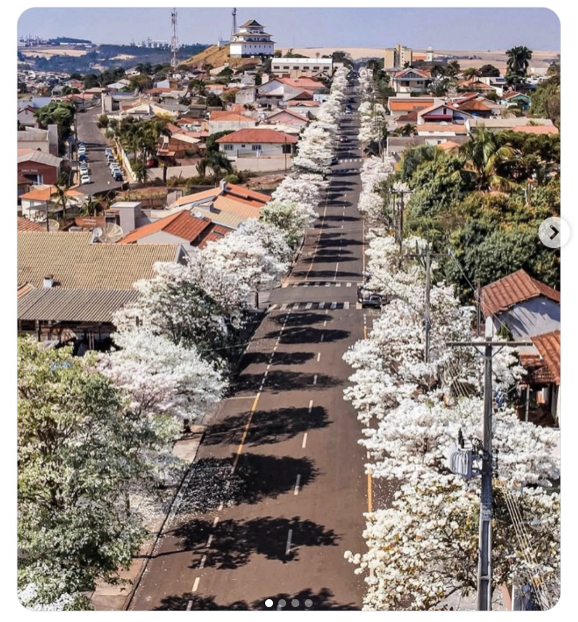
Assai, Parana, Brazil (Source: Photos by: @lud_porai)
Another small and rural 2026 ICF Top7 community is Assai, Paraná, in Brazil. This community has roughly 13,700 residents. However, when it was founded in 1920 by Japanese immigrants, Assai initially developed a population of 53,000 at the height of its cotton-growing heritage. In 2022, it adopted a strategic plan to attract investment, leading to partnerships with more than 90 firms. With Adobe announcing its first Brazilian design laboratory in Assai, this city became Brazil's first CityLab – a city as a living lab. The city's Sun Valley Experience brings together government, residents, businesses, and universities. Its main avenue features smart poles and smart traffic lights. Students learn about digital technology through its STEAM-learning environment. Despite its size and limited resources, its innovative governance has led Assaí to reach ICF’s Top7 for three years in a row between 2024 and 2026. Currently, it is the only Brazilian and Latin American city on ICF’s list. It has since gained a strong domestic and international reputation, amid dozens upon dozens of major awards and a recently announced post-secondary institution to be located in this small, rural community. The lesson to take away from Assaí is to invite companies to test their ideas in your community, with residents and students at the center. Learn more at: https://www.intelligentcommunity.org/assai_parana
Another 2026 Top7 Intelligent Community is Yunlin County in Taiwan. With 660,000 residents across a county of 19 townships and the county seat of Douliu, the county is not small by population. But it is framed here as a rural example. Yunlin reached the Top7 in 2024 and again in 2026. The county is best known for its agriculture and aquaculture strengths. It supplies roughly one in three of the vegetables and pork on Taiwan's tables. Yunlin has coupled its agricultural base with technology, including climate-smart farming, IoT, and AI-supported crop prediction, with a circular economy approach that turns waste into energy. It offers free WiFi in 219 public places and runs a STEAM program for students. Given its challenges with a growing aging demographic and loss of young people to the major cities across Taiwan, it is looking to technological, environmental, sustainability, and governance innovation as the key to its transformation. The lesson to take away from Yunlin is to treat agriculture as a technology sector and build skills locally, especially attracting and retaining youth as a key part of its transformation. Learn more at: https://www.intelligentcommunity.org/yunlin_county

National Yunlin University of Science and Technology Campus (Source: https://www.edarabia.com/national-yunlin-university-science-technology-douliu-taiwan/)
Las Rozas de Madrid is a community of 98,600 people. It offers multiple lessons for any community seeking to navigate AI, digital transformation, and innovation governance. In Las Rozas’ case, it treats innovation as a disciplined civic system, not simply as a collection of projects. Its leadership and stable governance structures allow for a culture of experimentation to benefit the community at large. By building this foundation, the city can outperform any model that chases isolated “smart city” pilots. Hence, it built a living lab culture, not a list of isolated projects. Las Rozas Innova operates as a permanent testbed for mobility, energy efficiency, digital education, and AI applications. A lesson from this is to create a strong innovation environment, widely accepted by the community, where experimentation is normal, safe, and governed. Another lesson is how to form public-private partnerships as engines of growth, especially in investing in foundational digital infrastructure, prerequisites for AI adoption. In fact, Las Rozas treats AI and robotics as part of a broader innovation ecosystem. Another key observation is how Las Rozas uses ICF participation as part of its international positioning strategy to attract investment, talent, and partnerships. Learn more at: https://www.intelligentcommunity.org/las_rozas_de_madrid.
What can others take away from meeting these unique communities when they come together in Columbus later this month? While these communities differ in size, geography, and culture, several themes repeat:
- Connectivity comes first, and affordability follows. Fairfield's subsidy and Northumberland's open network both focus on adoption, not just coverage.
- Partnerships are the engine. Assai with its corporate partners; Yunlin with agriculture and education partners; Northumberland and Las Rozas’ public-private partnerships are excellent examples. These demonstrate that no community builds alone.
- Local strengths beat borrowed models. None of these places tried to imitate a big city. Each had limited resources and built on what it already had.
- The process itself has value. Applying for an ICF Award (or Certification) forces a community to measure itself, align partners, and set direction, whether or not it wins an ICF award.
- Global benchmarking through an independent third party, such as ICF, can validate and amplify local credibility, identify invaluable competitive advantages, and accelerate learning.
Small and rural communities have plenty of company on the Smart21 list and plenty to offer. Get involved. Is your community ready to benchmark itself? ICF offers community assessment and certification pathways, as well as an annual awards cycle that begins with the Smart21. ICF is now looking for its next list of 2027 Smart21 Communities. Will your community be on that list?
To join the movement and experience the international network, learn more at https://www.intelligentcommunity.org/compete.
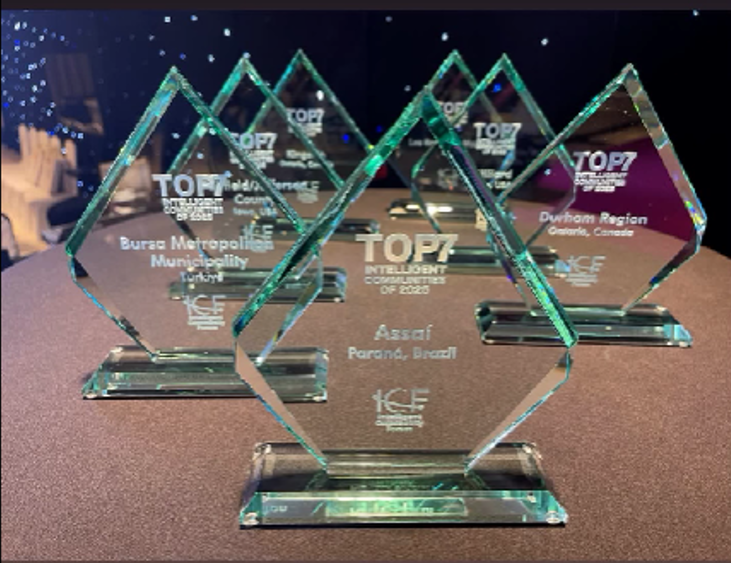
ICF’s Awards (Source: J.G. Jung)
